Fun, Easy, Fan Controlled
Streamline your event by partnering with a single technology provider to enhance fan engagement, digital sponsorship, and crowd data analysis
It is no secret that one of the biggest success factors for every startup is hiring the right talent. At AMPLIFi, we are passionate about surrounding ourselves with the right people; people who want to build something big, are curious to learn something new, are leaders in what they are passionate about, and are humans who applaud and empathize with others. We know that “the strength of the pack is the wolf, and the strength of the wolf is the pack”.
However, there is no easy formula for finding the right talent, especially in the startup world, where almost every startup can write a book on its hiring challenges. In this article, I will shed some light on and the steps we took at AMPLIFi to design our hiring process to overcome some of the challenges in pursuit of building the right team.
A common feature of any early-to-mid stage startup is that the team is pretty small, this sets substantial challenges for the company when it comes to hiring, like:
The small team size also imposes some requirements on a startup:
Understanding those limitations and requirements, how can we best find the right talent for a company at our size and stage, while not dedicating undue human and financial resources?
We defined two objectives:
After doing some research, reading about hiring literature, and talking to other startups, we came up with the following three main changes in the design of our process.
“If you cannot measure it, you cannot improve it”. We are true believers in this statement. Besides incorporating the most common metrics used to measure the efficiency of hiring, like conversion rates by stage and time to fill a position, we also defined a time to reject metric. This is the average time taken by our team before we identify that a candidate is not a good fit for AMPLIFi. Since our team has limited resources, our target was to optimize for the time spent on interviewing candidates while not missing on good ones.
In order to achieve this, we re-designed and standardized our interview process to become more efficient.
In order to be aware of how much time we spend on each candidate, without the overhead of manually tracking it, we standardized the number and order of touchpoints, and the expected time spent on each part of the applicant’s journey.
We continue to monitor our hiring metrics to adjust our touch points as we get better at identifying talent.
In order to compare candidates without personal bias, we standardized our interview process using score cards, and a pool of questions addressing the different competencies that we are testing for. A great source on recruiting in general, and designing score cards in particular, is “Who” by Geoff Smart. This was our main inspiration when designing the interview process at AMPLIFi.
The first step for us was identifying the key competencies that we
are looking for in each role, technically and culturally. In his
book, Geoff talks a lot about how to identify those competencies. We
laid out what each role is expected to add to the team, and
accordingly focused on the key, non-negotiable, technical
competencies for a candidate to be considered for that role. For
example, for our Product UX Designer role we identified that we need
someone who has experience with interactive installations, able to
build FUN and memorable user experiences, and has the mindset of
making design decisions supported by data findings. This drove how
we designed our case challenge and the scorecard for that role.
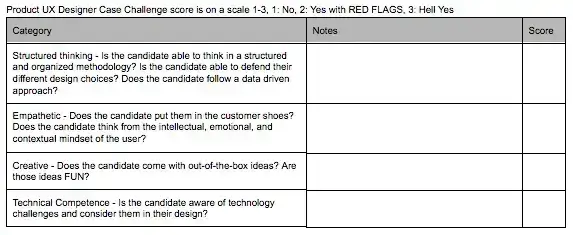
Example scorecard for candidate evaluation
We use a 3 scale point system to assess each competency: 1 – No, the candidate does not have the skill; 2 – Yes, the candidate has the skill; 3 – Hell Yes! The candidate is impressive at this skill. At the phone screening phase for example, we do not pass a candidate that lose more than 2 points.
Additionally, we went through multiple iterations of defining the culture we want to build at AMPLIFi, what worked in the past and what did not work. We built the foundation of our cultural manifesto in a company offsite, where we had an open discussion with all team members about how they perceive the company now, and how they would like to see it in the future. Having a deep understanding of the company culture, helped us identify what behavioural questions to ask and what an ideal answer should address.
Streamline your event by partnering with a single technology provider to enhance fan engagement, digital sponsorship, and crowd data analysis
Improving our hiring process has been an ongoing process, and we expect it to continue as the team grows. In the past 11 months, we learned about ourselves as much as we learned about hiring:
Based on measuring different hiring metrics, we were able to identify which parts of our hiring pipeline need improvement, and we are able to run experiments/make changes and track their impact to decide whether to keep them or not. We basically transformed our hiring process to an internal product which will now be the driving force of continuing AMPLIFi's success!
Want to see the process in action?